Este fin de semana he visitado Atlanta. Bueno, es un decir. En realidad he visitado el hotel Crowne Plaza. ¿Que para qué he ido a Atlanta a visitar sólo un hotel? ¿Es que es un hotel muy interesante? Noooo. Se trata de eso que pasa en los viajes, que vas conociendo gente y esa gente te permite conocer a otra gente, y…. En realidad, todo comenzó en Irlanda.
Uno de los meetups a los que asistía en Dublín se llama “Dublin polyamory meetup”. Fue allí donde aprendí la existencia y el significado de esa palabra, hasta entonces totalmente desconocida para mí: polyamory. Para ser una palabra inventada por angloparlantes, tiene su aquel que se basaran en un vocablo griego y uno latino, aunque se tomaron la libertad de cambiar “poli” por “poly”, y transformar “amor” en “amory”. Por nuestra parte, los españoles no somos menos imaginativos y somos capaces de inventarnos palabras como “footing”, cuyo significado en inglés nada tiene que ver con el que nosotros le hemos otorgado. Pero bueno, consideraciones lingüísticas aparte, pasé unos ratos muy interesantes con aquella gente, descubriendo que hay más personas de las que me podía imaginar que han traspasado los límites del tradicional concepto de la relación monogámica. Y lo más sorprendente fue constatar que se les veía bastante felices. Vamos, que eran realmente felices.
Como he mantenido el contacto con ellos, me contaron que en Atlanta se iba a celebrar una especie de congreso acerca de este asunto. Me informé, vi que tenía buena pinta, e intenté solucionar el problema del transporte preguntando al organizador si alguien de New Orleans iba a asistir. Me confirmó que sí, me puso en contacto con Petri y Charlotte, los cuales me dijeron que no tenían ningún inconveniente en llevarme. Tendría que compartir el asiento de atrás con Sacko, su hijo de 3 años, pero no había ningún problema. Así que me apunté al “Atlanta Polyweekend”.
Entre organizadores, ponentes y asistentes, nos juntamos allí más de un centenar de personas de todas las edades y espectro social. Incluso había un par con traje y corbata. Pero explicar aquí tres días de charlas con 15 ponencias, podría hacer esto muy indigesto, así que intentaré transmitir la esencia de lo allí vivido. Es simple: Hay mucha más gente de la que podemos imaginar que lleva numerosos años viviendo sus relaciones sentimentales saltándose “las normas”. Matrimonios que tienen otras parejas; familias formadas por 2 hombres y una mujer o viceversa (que viven los tres juntos, vaya; y esto puede darse con o sin hijos); familias de más de 3 (esto es más inusual, pero también se da); gente que tiene varias relaciones a la vez pero que viven solos; y todo lo anterior también se da en el mundo de los gays y lesbianas. Pero toda esta variedad de relaciones y otras que se me escapan ahora, comparten un mismo factor común: todos los miembros de la relación están de acuerdo en lo que hay. El engaño queda fuera de esta historia.
Ahora bien, el que todo esto exista y que pueda funcionar, no quiere decir que sea perfecto. Sucede lo mismo que con el modelo tradicional. La pareja monogámica funciona hasta que deja de funcionar y entonces uno se divorcia. Estos otros modelos adolecen de lo mismo, la relación puede funcionar perfectamente, pero un día puede dejar de hacerlo. La vida es así, no la he inventado yo… Así que las ponencias trataban de eso, de todos los problemas inherentes a estás situaciones, como los celos (tema fundamental), la organización del tiempo, los niños (amplio tema, con multitud de sub-temas relacionados), la resolución de los conflictos, los problemas legales, las relaciones con el entorno socio-familiar cercano… Una visión muy amplia de una realidad tan presente entre nosotros como desconocida.
Y ahora, no puedo evitar hacer mi valoración personal. Pienso que intentar decir (y no digamos imponer) lo que es correcto o incorrecto en materia de sentimientos, es un tremendo error. Una relación monogámica puede ser perfecta. Pero una relación poliamorosa, también. No hay reglas, no hay recetas, no hay una verdad universal. Puede haber tantos tipos de relaciones como personas. Los problemas surgen cuando nos aferramos a la idea de que las cosas sólo pueden ser como se nos ha enseñado toda la vida; y cuando eso falla, nuestra vida se desmorona sin encontrar salida ni explicación.
El viaje de vuelta fue tranquilo. Sacko dormía plácidamente y Petri, Charlotte y yo íbamos comentando relajadamente nuestras impresiones del fin de semana. Estabamos contentos. Quizá mi única queja, que también ellos compartían (y que comenté en la conferencia y también fue compartido por la mayoría), era que los organizadores plantearon la agenda con parámetros puramente norteamericanos. Me explicaré. Si un español organiza unas jornadas, lo primero que sitúa en la agenda son las horas de comer y las horas de cenar, y a partir de ahí, organiza el resto de la agenda. Bueno, pues un norteamericano, como aquí comen y cenan a salto de mata, se olvida de poner horas para comer y cenar, y las ponencias fueron todas seguidas sin un solo hueco para el descanso alimenticio y socialización reglamentarios… Detalles como estos son los que reflejan claramente la idiosincrasia de un pueblo. Estos chicos pueden tener la mentalidad muy abierta para algunas cosas, pero para otras…
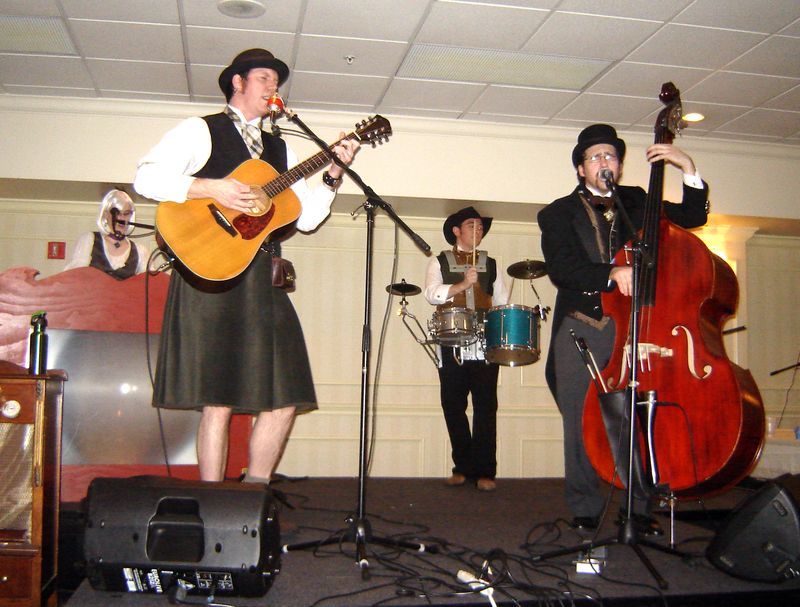
También tuvimos actuación nocturna: The Extraordinary Contraptions
I have visited Atlanta this weekend. Well, that’s a way to putting it. Actually, I’ve just visited the hotel Crowne Plaza. Why I’ve travelled to Atlanta only to visit a hotel? Is it an outstanding hotel? Noooo. It has to do with that situation which usually happens travelling when you are meeting people and those people introduce you more people, and… Actually, everything started in Ireland.
One of the meetups I joined there was the “Dublin polyamory meetup.” It was there where I learnt about that unknown word up until then: polyamory. English-speaking people made up this neologism mixing a Greek word and a Latin one, what it’s kind of fun. They only made a couple of changes, “poli” by “poly” and “amor” by “amory.” As for us, Spaniards are also imaginative and we are able to make up words as “footing” which real meaning has nothing to do with the one we meant. Anyhow, putting aside linguistic issues, I had a really good time with those guys. I learned that there are more people than I could imagine who have gone much further of the monogamy concept of relationships. And what was more surprising, I ascertained that they look happy. Well, they were truly happy.
Since I’ve been in contact with them so far, they told me about the Atlanta meeting. I found out the information, I thought it looked good, and I tried to sort out the transport issue. I asked the organizer whether he knew of someone else attending the meeting from New Orleans and he gave the contact of Petry and Charlotte. I called them and they were happy to give me the ride to Atlanta. I would have to share the back seat with their 3-y.o. child, but I didn’t complain about it, of course. Then, I signed up the “Atlanta Polyweekend.”
Adding up staff, speakers and attending people, we gather more than 100 people, with a wide range of backgrounds and age. Even a couple of people dressed in a suit. But put down in words 3 days scheduled with 15 presentations, would make this reading rather heavy going. So I’m going to try to give the general view of what I got there. And it’s simple: There are many people turning their back on traditional rules of conduct since a long while ago. There are married people who have other couples. There are families consisting of two man and one woman or vice versa (they all live together and there might be children also). There are families consisting of more than three people (this is not that usual, but it happens too). There are people having several relationships but living alone. And we’ll find all those situations also in the homosexual and lesbian world. But all these relationships and others that I can’t recall now are sharing a common factor: everyone involved in the relations agree with the situation. Cheating is out of this story.
However, despite the fact that this kind of relationships actually works well, that doesn’t imply to be a perfect situation. Actually, we’ll find problems as we find them on the traditional model. The monogamy relationship works until it doesn’t work anymore, then the couple might divorce. Both models have identical problem, the relationship might not last forever and ever. This is life; I didn’t make up life the way it is… Then, the presentations were dealing with all these issues, with all the troubles related to this kind of relationships: jealousy (main topic), timing, kids (big topic with many things to discuss about), conflict resolution, legal issues, relation with the familiar and social environment… Presentations cover all this matters which are as real as unknown.
And now I can’t help give my personal point of view. I reckon that there is no point on saying what is correct and what’s not when it comes to feelings. And less acceptable if there is an imposition. A monogamy relation can work perfectly as well as a polyamory relation. There are no rules, no recipes, no universal truth. There are as many types of relationships as people are. Problems show up when we hold the idea that there is only one way to work out relationships, and this is the traditional way we have been always thought. And when the ends don’t come together we don’t find an explanation to that and life crumbles.
The way back to New Orleans was quite and calm. Sacko was dog sleep and Petry, Charlotte and I were chatting about our impressions of the weekend. We felt happy. Maybe my only complain (which they and also many people at the meeting shared with me) was the American-style schedule made by the organizers. I’m going to explain myself better. A Spaniard who had to set up a meeting would firstly fit the lunch and dinner times into the schedule. But an American, since having lunch here doesn’t have the social importance that has in Spain, may forget to make room in the schedule to have lunch and dinner… That’s what happened this weekend. The entire presentations were straight in a row all day long with no time to rest. This kind of details tells a lot about the idiosyncrasy of a country. Theses guys might be really open-minded for some stuff, but for some other situations…

#1 by morigan on 29 marzo, 2011 - 10:07
Citar
Bueno, es una opcion muy minoritaria, pero una opción al fin y al cabo. Si veces ya resulta dificil entenderse con una sola pareja, no quiero ni imaginarme lo que seria una disputa familiar entre tres (o cuatro…)
#2 by Aupaedurne on 29 marzo, 2011 - 21:24
Citar
Míralo en positivo, no tienes porqué discutir con todo el mundo a la vez. Más bien al contrario, si discutes con uno, siempre puedes encontrar consuelo en el otro. Como dicen en movistar (creo) “compartida, la vida es más”
En cuanto a las minorías, no sé, pero si la gente se quitara las vendas y las orejeras, se daría cuenta de q no es tan minoritario, q de hecho un tanto por ciento muy elevado de gente “normal” ha tenido en algún mto de su vida una pareja de más de dos. La pena es la educación, sobre todo religiosa, la fuerza de la costumbre y el maldito quedirán. Si no fuera por eso, seríamos todos mucho más felices pq seríamos más libres.
Hala, toma soflama!
#3 by G on 30 marzo, 2011 - 5:19
Citar
Un placer otra vez hablar contigo esta noche. Escribo para enviarte mi “email address” para que puedas mandarme el suyo. Hasta la proxima reunion, G
#4 by jlpueser on 30 marzo, 2011 - 6:01
Citar
Me gusta Aupaedurne con su visión positiva de la vida, qué maja…
Hey, George, saludos! Sí, para mi también es un placer charlar contigo. Eres uno de esos Americanos que hacen que merezca la pena venir a este país.